Rasein

Rasein was once a shtetl (a Jewish village) like all other small Jewish villages of the past in Lithuania.  In truth, there it was given due honur and called – a town.  It was quite unlike Boiberik or Yehupetz of Shalom Aleichem fame and certainly unlike the city of Odessa, since it had a mere 8,000 residents most of whom were Jews.  Indeed, for this very reason it could never be called a town.  It was purportedly distinguished for being much larger than the usual little village, meaning that Rasein was between a town and a shtetl – it was simply in the middle.  It had all that any human being required for his daily needs.  Firstly, it was crowned by that eminent former Rabbi Nathan Zvi Finkel, of blessed righteous memory.

Who was in fact the distinguished personality Nathan Zvi Finkel?  For what reason was he so famous?  He was born in Rasein in the year 1874.  Already, at age 15 he displayed a remarkable knowledge of the Torah and had by then published his commentaries on the Tanach.  The Kelmer Gaon, Rabbi Eliezer Gutman, gave him his daughter in marriage.  He made it his aim to inculcate Yiddishkeit – Jewish tradition – among the younger generation.  He was one of the founders of the Telshe and Slotzker yeshivas and later also in Slobodka (Kovna), which he named “Knesset Israel”.  In the course of time, hundreds of scholars studied at this yeshiva and it grew.  The greatest yeshiva in Lithuania.  The rabbi was simply known as “grandfather”, since he was so beloved by his pupils like a grandfather by his grandchildren – “the grand father of Slobodka Yeshiva”.

The story is told that once a boy turned up in Rabbi Finkel’s apartment on a cold an frosty winter’s night without a wrapping around his neck.  The rabbi took the scarf from his own neck and handing it to the youth said; “I know that you have a chill, so take this and wear it in good health.”  He also gave him his watch to pawn so as to get money for food.  The famous Hafetz Haim once said; I produce books and Rabbi Nathan Zvi Finkel “creates” the human being.  Rabbi Finkel was famous throughout the whole world.  When many of his Slobodka yeshiva scholars settled in Hebron, he himself went to settle in Eretz, Israel.  Later he died from a very arduous illness.

Among the high-born of Rasein, a place of honour is reserved for Rabbi Markowitz, Shlomo Kalman Tuvia, of blessed righteous memory; born in 1880 he perished in the Kovne Ghetto.  Another eminent Rasein-born rabbi was Rabbi Yehezkiel Lifshitz, son of Aryeh, of blessed righteous memory, who was born in 1877 and served as a rabbi in Yorberik and other Jewish communities.  He was once the representative of the president of the Federation of Rabbis in Poland; he visited the United States of America and Canada at the invitation of the local Rabbinical Councils.  He published numerous books and commentaries on the Torah and the Talmud.  Thus Rasein played an important role among those one-time small Lithuanian Jewish towns and villages.

Not only did Rasein have among its residents there above-mentioned geniuses, it also had its fair share of astute Jews and sages and naturally too of fools.  There were even two and a half crazies, one of whom was uncontrollable and had to be kept in a locked room with bars on the window, where he could scream, sing, cry and laugh undisturbed.  There his relatives would bring him his meals.  In the shtetl there was also a crazed woman who was known as Gitel-Gitel, the madwoman.  In the summer, she would roam the streets passing the houses and shouting, banging and breaking anything she had a mind to, and even lifting a hand against people.  In her home, she would break plates, damage the furniture and do much other mischief.  In the winter, she became normal buying new dishes; she would paint her house and repair the damage done.  She also apologized to those Jews in the shtetl whom she had harmed… She lived with her husband and it is told that she became crazy straight after the wedding.  They had an only child, a beautiful boy.  Unfortunately, after an unsuccessful operation – an appendectomy – he died.  This too had its effect on Gitel and she became crazed, though strangely this craziness manifested itself only in the summer.  No medicines could be found to bring about a cure.  With the Nazi occupation of Lithuania, the first victims were the crazed; the Nazis were more afraid of them than of normal people.

Rasein had twelve study and prayer houses and a central synagogue in the middle of the town.  Almost all the different stores in the town were owned by Jews, many of whose signs were printed in both Yiddish and Lithuanian.  There were all sorts of craftsmen, an inn, a cinema, a printing shop and, of course, the famous Shvirskes dairy shop.  You could buy there fresh milk, cheese, and a bottle of tasty soda water was well as the well-known Rosmarin’s ice-cream.

The Jews had their own cemetery in Rasein, where you could order a tombstone on the spot.  Near the cemetery was the prison and not the usual one.  It was certainly intended for political detainees, each of whom was given a separate cell.  In fact, it was almost a Jewish prison, since most of its inmates were Jews.

What is there left to tell you?  Yes, there was a Cheder, a school and a cultural center, and a fairly large library.  Almost all the tables in the reading room were usually occupied.  At the subscribers’ table there was a row of readers who wished to change book and the table itself was often piled up with books so that one could hardly see the face of the librarian.  It was here that one could find Yiddish newspapers and journals from throughout Europe and a variety of Yiddish books from all parts of the world.

Greenery surrounded Rasein and grew in its center.  It covered the snouts of the hunchbacked or closely packed wooden houses and squeezed through the bricks themselves.  There was also a fairly large green park with hundreds of trees and shrubs, whose shade gave pleasure to the Jews on the Sabbath and the gentiles on Sundays.  There was no lack of squares, but on the Sabbath, many couples loved to take walks outside the village and enjoy the open air.  Not far off a brook swam into sight, known as the Raseike.  Whether the shtetl was named after this stream or vice versa is no longer relevant.  It was told that at one time the brook was a deep one, but now it merely reached to a child’s belly.  To take a dip one had to sit in the water or lie down on the stony waterbed.  That’s why it was easy to do all kinds of stunts in the water; stand on one’s head, make pyramids, roll around, splash around, tease the stream and try to chase the backwash and other such silliness that may come to mind.  On Sabbath, Jewish couples would stroll to the stream.  It would be teeming with youngsters, so that pleasure-seeking young men and adults preferred to go bathing in another, much larger and deeper stream, called the Dubisa.  This stream was quite far from Rasein, so that most people rode there to avoid the long walk on foot.  One could only permit oneself this pleasure on weekdays or during vacations.  But most Jews worked hard the whole week and they never gave a thought to any such recreation, which they left for the youth to enjoy.  Nearby, the stream branched off into very beautiful waterfalls, underneath which it was pleasant to cool oneself from the heat in summer.

The roads in the village were straight and stretched out long; they were paved with stones from the fields and the pavements were made of cement blocks.  Not just because it was my shtetl, since for each one his village, his birthplace, has a precious place in his memory, but indeed my shtetl, Rasein, was clean, homey, most of whose inhabitants were honest, and friendly, despite the fact that, like elsewhere, there were many and diverse political parties, to the left and to the right.  There were arguments too among them, which were sometimes resolved by a bout of fisti-cuffs when they felt that the advantage over the other could only be gained by a fight.  I was on the Right, but I would never fight over a few votes.  At other times, silence was the best option.

Rasein had of course a Schochet and a slaughterhouse, where we young lads or women would bring hens to be slaughtered, mostly on Friday afternoons or the eve of holydays.  There was also a Mohel.  There was a rabbi or a Dayan for whom the Jewish community had great respect.  Half-an-hour before the Sabbath, a loud whistle would come from Perlov’s sawmill, so loud that it could be heard even by the deaf.  The sound of the whistle reached every corner of the shtetl.  This Perlov had a mill.  On the eve of Shabbath, a few minutes before candle-lighting, the siren whistling was again heard coming from Perlov’s sawmill and mill, so that not only the local Jews, but also those in the surrounding rural dwellings knew that the Sabbath was approaching and the housewives would start preparing for candlelighting.  The gentiles too were aware of the approaching Jewish Shabbath.  The hooha stopped, and men dressed in their Sabbath best would each wend his way to his synagogue.  Their wives prepared the Sabbath dinner table; they had managed before the onset of Shabbat to ready the cholent in its special pot for the next day and to place it in the brick oven at the bakery, as the simple Jewish housewife was won’t to do; so that Saturday afternoon after the morning prayers they could bring home the hot delicacy.  Indeed, most of the Jews here followed the precept “Six days will you work and do your weekly labors and on the seventh will you rest from these and do not work, you and your son and your servant and your wife and your cattle and the stranger within your gate.”

So they lived week by week, the poor, the rich, all alike – even the so-called heretics (apikorsim) rested on the Sabbath.  There were almost no light vehicles; and no buses on Shabbat.  Most of the movement on the roads was by the horse and buggy and bicycles.  The “Jewish” horses also rested on the Sabbath.  Thus, peace and quiet reigned in the shtetl on the Sabbath.  Only on weekdays could often be hard the clop clop of horseshoes on the cobbles and the hammering of carts and buggy wheels.

It happened one day that I was carried into my home.  A cyclist had run over me.  When I finally recovered, I decided that rather than lie under the wheels of a bicycle I preferred to ride on top of them.  I had long cherished this dream in my memory, until it was finally realized when I became a little older.

And so the Jews in my shtetl lived, worked, studied, celebrated and mourned, fought and made peace with each other, dreamed and hoped for better times.  There was love and jealousy, but no evil was committed by one against the other.

The youth grew up with new ideas and dreams.  Most of them had leanings towards Zionism and dreamed of going to build their own land.  Eretz Israel was the main destination of their dreams.  To this end they prepared themselves, created kibbutzim and clubs; whether it was Betar, Poel Hamizrachi, or Poalei Agudat Israel, Poalei Zion or other branches of these, their sights were set on the Near East.

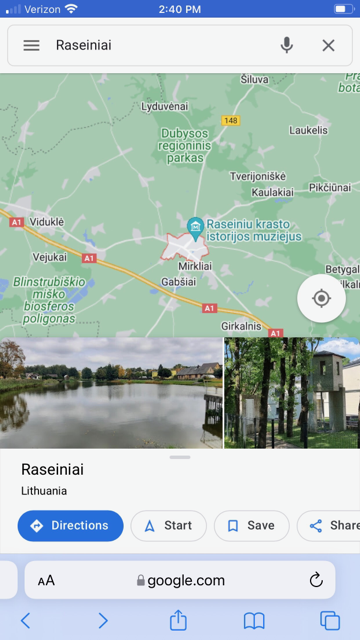
Should you ever wish to visit my shtetl, you ought to know that no train goes there, the nearest railway station is at Widokla about eight kilometers away.  Rasein is located on the highway of Kovno-Kleipeda (Memel), about seventy kilometers from Kovno.  The nearest surrounding villages are Tawrik, Shidleva, Kel, Nemaksht, Beitegola.
The legacy lives on…


My final chapter is about the legacy that Don and Eunice have left us all.  This is the hardest part to write.  This is where the artist creates a perfect picture, the poet the best poem.  The photographer captures his best picture.  I don’t know how to do this part so I asked for help from others.


Random memories:


From a Comstock Park parent:  When Ellen was three years old she had a significant hearing/speech problem.  Don Buning arranged for her to spend time every week with the Stoney Creek Speech teacher the year before she started kindergarten. These lessons were very helpful to Ellen. Ellen felt very important about going to school and greeting “Mr. Bunny” and the school secretary when she entered.  Then, one day in the spring there was a kindergarten readiness day where the next year’s class was “tested” by teachers. Mrs. Waters advised that Ellen should be held back, that she was not ready and would not succeed in school. Her reasoning was that she did not see in Ellen the fear or intimidation of a day in school and of being tested.  Ellen did go on to kindergarten. Today Ellen is the Senior Engineer, Infiniband and Host Ethernet Hypervisor Development at IBM in Rochester, MN.


I remember all the vacations we went on.  How we left so early in the morning, stayed in campers, and sat around camp fires.  Little did I know that this was an experience most kids did not get growing up.  I figured at the time that all kids went to Disneyland, the Badlands, the Grand Canyon, Maine and Arcadia National Park, Yellowstone, Mexico and Colorado.  I took for granted the summers at Eastern Tennessee State University,  Western Washington, and Rhode Island.


I remember how special Christmas was.  How the carols would start on December 1, I remember all the games we played, the company visiting, the shows we watched and how we always got up so darn early on Christmas day.  I took good cooking and good food for granted.  I assumed all kids could go to the school gym the day after Christmas and have five hours of PE.  I remember the annual slide show and thinking how everyone was so much younger then.


I remember Sunday afternoon dinners growing up.  We always went to church in the morning and then always had a home-cooked sit down dinner after church with grandparents.  The conversations were usually silly but always priceless.


I remember a couple acts of kindness that meant a lot to me:  Mom and Dad swapped cars with us our first Thanksgiving, so that we could pull the little red trailer with a couch in it to our apartment in Champaign.  We swapped back at Christmas, with a ding in their front fender.  (Fortunately, Dave was driving.)  Mom and Dad gave us their bed at Christmas break, the year that I was pregnant with Julie.  Mom flew down to Raleigh, all by herself, (first time ever), to help me with Jamie and Julie when Dave had to be gone for a week. And, of course, Dad and his toolbox have saved us many a time.

Retirement


Don retired on January 27, 1989 midway through the 1988-1989 school years.  He wanted to give the new principal an opportunity to start at the beginning of the second semester.  At first the “retirement plan” was to buy a motor home and travel.  They did that.  In the winter of 1990, they took a motor home they purchased and spent that winter in Florida.  In the winter of 1991, they spent the winter in Texas.  In the winter of 1992, they went back to Florida with their motor home and found a park in Florida called Holiday Travel Resort.  They really liked this place and met several friends.  Don and Eunice decided to sell the motor home and rented a place at Holiday Travel Resort for three years until they finally bought a place and have gone every winter since.  They currently own a place at 28229 CR33 Lot 55C Leesburg, Florida.  They have several friends at the park and remain active all winter.  The Groening’s from Maine are real special friends.


Don’s Career

Don’s career started at Grandville High School teaching woodshop class from 1956 – 1960.  During this time both Dave and Doug were born.  Don and Eunice lived in Burlingame, Wyoming renting a house for a year and a half then bought a home on 3479 Bluebird.


From 1960 – 1962, Don taught at East Elementary in Grandville, Michigan teaching 6th graders.  During this time Dan was born, living at 3479 Bluebird.


From 1962 – 1972, Don was a principal at Stoney Creek Elementary in Comstock Park, Michigan.  During this time, Becky was born.   Don was the principal of Stoney Creek for 10 years.  The school was brand new when it opened and he was the first principal the school ever had.  A picture of him was hung in the hallway when he left.  The school had over 600 students when it opened up.   During this time, Don and Eunice moved next door to a house they built at 3487 Bluebird.  The house was built in 1965 by the Meekhoff brothers.  Don did some of the work himself.  He put siding on the house, painted it, put in the hot water heater, plaster board, roof and treated it for termites.


From 1972 – 1989, Don was the principal of Pinewood Elementary in Jenison, Michigan.  He retired on January 27, 1989.  He was at Pinewood for 16 ½ years.  He left Stoney Creek Elementary because he was encouraged by the superintendent of Jenison schools to apply.  Both Dan and Becky had him as their principal.  In 1971, Eunice fell roller skating (remember how they met?) and hurt her knee.  She was not to climb stairs daily so Don and Eunice moved to 7932 22nd in Jenison, Michigan in 1971.  For one year, Don commuted from Jenison to Comstock Park then became principal of Pinewood and lived less than one half mile from the school.  He retired January 27, 1989 from Pinewood Elementary.


After retirement, Don taught fall teacher’s education for five years at Grand Valley State University.  In 1998, Don and Eunice moved from the house at 7932 22nd to a retirement home not far from 22nd at 2667 Cedar Grove Court and are still living there today.


In all Don had 32 ½ years in education having bought two years for the time he was in the Navy.    The impacted lives are countless.

Children

Don and Eunice had four children:


Dave born April 27, 1956 in Kalamazoo, Michigan

Doug born April 21, 1959 in Grand Rapids, Michigan

Dan born October 2, 1961 in Grand Rapids, Michigan

Rebecca born October 6, 1966 in Grand Rapids, Michigan


Dave was born at Bronson Hospital in Kalamazoo, Michigan in 1956 (while Dad was attending Western Michigan University). He attended Calvin Christian High School, and then went to Calvin College in Grand Rapids, Michigan where he earned his BS degree in Psychology. Dave met Sue Holsem in high school and they were married in Grandville, Michigan on January 21, 1978, after Sue graduated from the University of Michigan. Dave and Sue both earned Masters Degrees (in Industrial Psychology and Accounting) at the University of Illinois in Champaign, Illinois; and Dave also taught Social Psychology there for 3 years. After college they went on an internship with IBM in Armonk, NY and that led to a job at IBM in Raleigh, North Carolina where they live today. Sue and Dave have three children: Jamie, born November 6, 1980; Julie, born July 2, 1986; and Steven, born June 9, 1990.


Doug was born in Grand Rapids, Michigan on April 21, 1959.  He graduated from Jenison High School in 1977 and then went on to earn an associate degree from Grand Rapids Junior College in 1979, a bachelor degree in education from Grand Valley State University in 1982 and masters degrees from Emporia State University in 1992 in curriculum and instruction and in counseling in 1998.  Doug worked teaching middle school in El Dorado, Kansas for six years and then in Shawnee Mission, Kansas from 1988 until now becoming a counselor at Shawnee Mission South in 2001 and the counselor coordinator since 2002.  Doug met Kathy Macklin in high school and they were married in Goddard, Kansas on July 14, 1979.  They have three children: Lisa born March 14, 1982 and Kim born July 28, 1984 and Jennie born September 17, 1986.


Dan was born in Grand Rapids, Michigan on October 2, 1961.  He graduated from Jenison High School in 1980 and went on to earn a bachelor degree in economics from Calvin College in 1984.  After graduation, Dan worked at Steelcase from 1985 until 2005.  He is currently employed at Tennant in Zeeland, Michigan.  He earned another bachelor degree in finance from Davenport in 1998.   Dan met Beth Anderson in college and they were married in Jenison, Michigan on June 20, 1986.  They have three children: Hannah born June 26, 1990 and Kinsey born January 28, 1994 and Leah born August 9, 2001.


Rebecca (Becky) was born in Grand Rapids, Michigan on October 6, 1966.  She graduated from Jenison High School in 1984.  She earned a bachelor degree from Hope College in 1988, with a double major in secondary education and Spanish.  She taught Spanish in Allendale from 1988 – 1990 and then was hired to teach in Zeeland in 1990 and is still teaching their now.  Becky met Dave Purnell in 1997 and they were married on July 11, 1998.  They have 2 children:  Anna born June 16, 1994 and Ellyn born April 16, 2000.

Marriage

Don and Eunice got married on June 17, 1955.  They met during spring break in 1951 at a church roller skating party.   Kalamazoo Christian Reformed Church was having a roller skating party and Eunice went with her friend Mary Bosker.  Don was writing a paper during spring break while attending Grand Rapids Junior College and he needed a break from writing the paper.  He and his cousin Homer decided to attend the same skating party.

In May of 1952, Don joined the Navy.

Don and Eunice dated during the 2 ½ years while he was in the Navy.  Don got out of the Navy in October of 1954 and they got married in June of 1955.  Don finished his degree after the Navy at Western Michigan during which time they both stayed in a dorm at Western Michigan.

The marriage took place at Pinerest Christian Children’s Home in Cutlerville, Michigan.  Eunice taught Sunday school there so they could rent the chapel for free.  They wanted to get married on a different day but the chapel was being used by the preacher’s daughter so they picked June 17 instead.


The day of the wedding was a hot day and the church did not have air conditioning.  Uncle Abe sang during the wedding.  Al, Don’s brother was the best man.  Mary Bosker, a friend on Eunice’s was the maid of honor.  Aunt Helen was a bridesmaid as well as Beth Devries, Eunice’s brother’s wife.  After the wedding ceremony, there was a sit down supper in the church basement at First Church in Cutlerville catered by Jennie Devries (Eunice’s mom).   Once the dinner was over, the couple got in their car and headed to a local Motel.  They were followed by three college roommates that were going to harass Don and Eunice at the hotel.  Don’s Brother Al saved the day because he was the first car behind them and led them to a narrow gravel road that had a one lane bridge.  Al stopped and parked on the bridge and Don and Eunice were able to drive merrily on.

Don and Eunice honeymooned in Colorado for three weeks on $300.  They cooked most of their meals on a Coleman gas stove and ate on a collapsible table which they had taken along.  The limit for a hotel room was $7 a night and each room was checked out before it was paid for.  They had ten flat tires during the three week trip.

In the summer of 2005, the entire family went to Chicago, Illinois and spent a week at Pheasant Run Resort in St. Charles, Illinois.  We were lucky that everyone was able to attend this event which was a celebration of 50 years of marriage between Don and Eunice.

Navy/Post High School


Don was in the Navy from May of 1952 until October of 1954.  He was an Aviation Electronic Technician.  He had to take a test to get in to the school and he scored really high.  It was the hardest school to get into.  His Navy career started in Great Lakes, Illinois in boot camp.  Boot camp was tough.  He described hell week as one week were he learned many things but mostly about discipline.   He then went to an AV prep school in Norman Oklahoma and then on to Aviation Electronics School in Memphis Tenn.  After AE School he had a choice of billets and he could have been assigned to Olathe KS but everyone said the place was nowhere and boring so he chose Commander Forces Far East.  He was assigned to a base at Iwakuni Japan where he spent almost two years.  He said that the Navy was a valuable experience and if he had the opportunity he would do it all over again. One of the things he ended up doing was spending a month aboard a seaplane tender and sailed to Hong Kong where he purchased a wedding set.  To this day he gets choked up in Veterans Day parades and honors and remains loyal to the Navy


After the Navy, Don wanted to finish his degree at Western Michigan University.  He had also met a wonderful young lady named Eunice who he would later marry in 1955.  He ended up going to Western Michigan from 1954 until he got his BA degree in 1956 and an MA in 1960.  Unlike the Navy, Don does not feel as loyal to Western Michigan.   Don lived in the dorm for the first semester and after marriage he and Eunice lived together for one year in a cheap duplex and their focus was to get a degree and finish the program.  The two of them pretty much scraped by while they were there.  Don had a ladder on the dorm lot near where they parked their car so that when a job came up around town he could throw his ladder on his car and go do the work.  He mostly roofed, painted, pointed chimneys, cut branches and simonized cars for $5.  Don became a teacher because an Aunt who his parents really respected was a teacher and she always had a job during the depression years.   After graduation from Western Michigan, both Don and Eunice and little Dave moved to Wyoming and rented a home on Burlingame Ave for about nine months and then bought their first home at 3487 Bluebird as Don started his teaching career.

If you ain’t Dutch you ain’t much


Chapter 1: Dutch   To start, both sets of Don and Eunice’s parents came from the Netherlands.  The Dutch heritage has certain characteristics.  I have come to be very proud of the heritage but I asked my brother’s and sister’s what it’s like to be Dutch.  Some random responses:


  • I don’t see that penny pinching so much in this generation of American Dutchies. The first/second generations of Dutch immigrants were clearly looking for ways to save and/or not spend money. I think by the current generation this trait is gradually being lost.
  • Drink lots of hot, dark coffee.
  • Hit the second hand stores for stuff that is as “good as or better than new – considering the price.”
  • Borrow and lend…not money but tools, trailers, eggs, etc
  • Do it yourself, even if you can’t
  • Know the value of things and able to spot a deal
  • Go to church or feel guilty about it
  • Smoke…changing, fortunately.
  • Eat liquor soaked raisins using toothpicks and eat mashed potatoes with other vegetables stirred in.
  • Basically, I think the American Dutch trait is a lack of other ethnic traits. It’s like when Loa Tsu was asked to define the Tao he’d say “It’s not this and it’s not that and not this and it’s not that.” Look for someone without Italian characteristics or French or Hawaiian…that’s the Dutch guy. I guess we’ve assimilated
  • The Dutch were green before green was cool. If something can be saved and reused, it will get saved and reused. If there is a place to pinch a penny, we’ll pinch it! If something is worth buying, it’s worth buying after it fell off the truck, too…and a better deal. We’ll look to save where we can, but in ways that are all above board.
  • Tall and blond
  • Eat bulk and brie and pigs in the blanket
  • Frugal with your money
  • Not very outwardly affectionate
  • Plant tulips in your yard
  • Drive a car with over 100,000 miles
  • Make sure your car is washed before church on Sunday
  • Go to church 2 times a week
  • Stand up when Veterans march by in the parade
  • Drink beer but don’t want it sold in your town


Other Dutch facts:

  • As of 1991, November 16th is “Dutch-American Heritage Day”.
  • According to the 2000 United States Census more than 5 million Americans claim total or partial Dutch heritage. They are particularly concentrated around Grand Rapids, Michigan   Sioux City, Iowa, and Des Moines, Iowa.
  • Dutch cheeses are world renowned with famous cheeses such as Gouda, Edam and Leiden.
  • The Dutch have all sorts of pastry and cookies (the word “cookie” is in fact derived from Dutch), many of them filled with marzipan, almond and chocolate.

We have very much enjoyed, helping people gather, tell, and preserve their life stories over the last several years.

At this time, life has other plans for us, so we are ceasing operations at Porch Swing.

If you have any questions please contact us at info@porchswingstories.com

We recommend that you save any stories you placed on your Storysite that you choose to keep prior to December 31, 2025. (Open the chapter you want to save, hit Edit My Chapter, and copy and paste to Microsoft Word or another format.)

Thanks!